

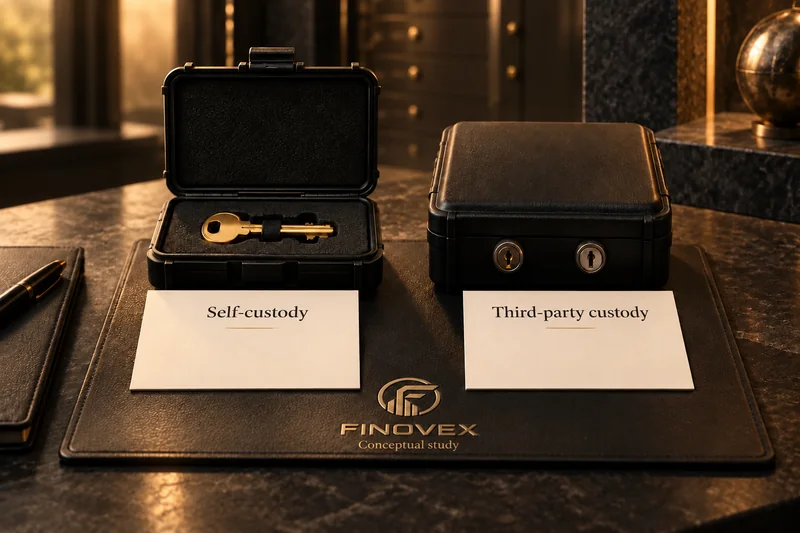
The difference starts with control of the assets
Comparing self-custody and third-party custody means looking beyond convenience. Identify who can sign a movement, how access is recovered and what happens if a person or a service becomes unavailable. Each model concentrates responsibilities in different places.
In self-custody, the care of the keys, the recovery copies, the devices and the continuity of access is yours. Losing a key or exposing the recovery phrase can compromise the assets. A cover should not be assumed for these events: its scope depends on the published conditions.
In third-party custody, part of the control depends on the provider's processes. Examine who operates the keys, who authorises movements and how the assets can be returned. A cover may provide for specific events in that relationship, but it does not remove the dependence on the service.
The number of signatures and independence are separate questions
In a “three of five” arrangement, three signatures meet the quorum out of five possible keys. To assess control, it is also necessary to know who holds those keys, on which devices they sit and by which procedures they are recovered. The number does not reveal those dependencies.
If several keys share a device, a recovery account or a vulnerable process, one incident can compromise more than one of them. That does not automatically turn every signature into a single one; it shows that the expected independence has to be examined in practice.
Assess what remains after the controls
Compare the care each arrangement requires with the ability to carry it out and keep it up. Self-custody and third-party custody involve different knowledge and responsibilities. There is no distribution that suits every person and every operation.
Residual exposure is what remains after the controls that were adopted. To assess a cover, relate that exposure to the events provided for, the costs, the limits and the exclusions. The protection contract and the assessment of the custody model answer different questions and should be considered together.